
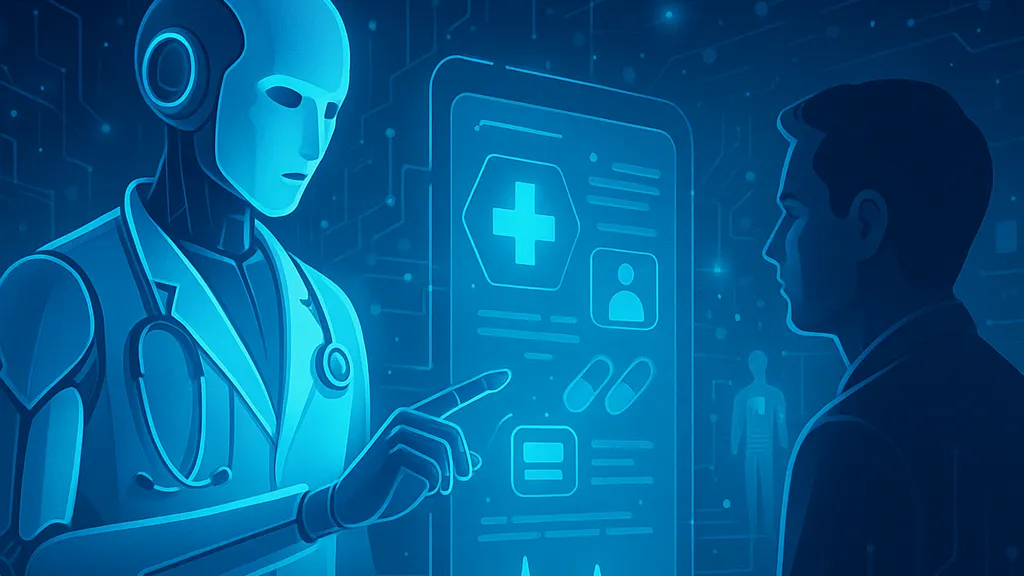
Imagine a hospital where doctorsare not people in white coats, but AI-powered agents, which patientscan consult to receive diagnoses and get personalized treatment plans.
Welcome to Agent Hospital, a virtual medical world where thousands of digital doctors and patients interact inside a living simulation. Created by the Institute for AI Industry Research at Tsinghua University, this project reimagines healthcare as a self-learning ecosystem: a place where algorithms train one another through millions of simulated cases, evolving medical intelligence at a speed no human institution could match.
But, What Is Agent Hospital and How Does It Work?
Agent Hospital is a fully virtual medical ecosystem where doctors, nurses, and patients exist as autonomous agents powered by Large Language Models (LLMs) and specialized AI modules. Designed to mirror the complexity of real-world healthcare, the system simulates complete medical journeys encompassing triage, consultation, diagnosis, treatment, and follow-up. Within this environment, AI doctors collaborate across multiple specialties, interpreting patient data, reasoning through symptoms, and making clinical decisions that evolve dynamically as new information emerges. What sets Agent Hospital apart is its remarkable scale and learning efficiency: by running continuous simulations, each AI physician can encounter and treat tens of thousands of virtual cases in just a few days, compressing years of human medical training. The platform is a self-improving network, analyzing its own errors, refining its reasoning, and enhancing its decision-making strategies, creating a living laboratory where medical intelligence grows faster than ever before.
Why Does It Matter?
Agent Hospital represents a significant leap in how AI can be developed and applied in medicine. Beyond research, the platform holds immense potential for medical education and healthcare infrastructure, offering a space where students, policymakers, and AI systems can safely explore strategies for complex situations like pandemics or resource allocation. Because Agent Hospital relies primarily on synthetic patients, it also shifts the data governance landscape, reducing dependence on sensitive real-world datasets. However, as such systems move closer to real-world deployment, crucial challenges around data privacy, patient consent, and algorithmic fairness will resurface.
What Isn’t… Yet
Although Agent Hospital represents a remarkable technological milestone, it remains a virtual prototype rather than a fully operational physical facility where autonomous AI systems treat real patients without human supervision. Its current goal is to explore and refine how intelligent agents perform within realistic clinical simulations, offering a controlled environment to test the boundaries of AI-driven medicine. Some reports suggest that pilot deployments or limited real-world applications may be forthcoming, but before such systems can be trusted in actual healthcare contexts, major regulatory, ethical, and safety challenges must be resolved. Foremost among these are questions of accountability and liability: if an AI doctor makes a mistake, responsibility must be clearly defined. Equally pressing is transparency, since both clinicians and patients need to understand how algorithmic decisions are made, particularly when lives are at stake. Despite the use of simulated data to mitigate bias, issues of fairness and data integritypersist, as agent models can still internalize flawed assumptions from their training environments. Beyond the technical concerns lies the enduring need for human judgment and empathy, qualities no machine can yet reproduce. Additionally, privacy and data governance remain critical: even if synthetic patients dominate the training process, future integrations with real data will demand rigorous consent, anonymization, and oversight protocols. Bridging the gap from simulation to practice requires establishing robustregulatory frameworks, new standards for AI-driven clinical evaluation, and assurance that these systems can generalize safely to the messy, unpredictable reality of human healthcare.
What Might the Future Hold?
The future of Agent Hospital points toward a new model of care where. AI agents and human physicians work jointly: machines efficiently managing repetitive, data-intensive tasks, and doctors focusing on complex, compassionate, and ethical dimensions of healing. In regions struggling with physician shortages, such systems could redefine accessibility, providing scalable triage, diagnosis, and follow-up care at minimal cost. Beyond clinical practice, Agent Hospital signals a transformation in medical education: immersive simulations could allow students and professionals to engage with thousands of realistic clinical cases, including rare and high-risk scenarios, within a safe, controlled environment. As the technology matures, its convergence with innovations such as the Internet of Things, remote monitoring, and genomics may give rise to an interconnected ecosystem of precision medicine and intelligent hospital infrastructure.
Agent Hospital is, for now, a glimpse into a possible future, one where human compassion and artificial intelligence converge to create a more accessible, adaptive, and intelligent form of medicine. Whether that vision becomes reality will depend not only on technological breakthroughs, but on how wisely and responsibly we choose to shape them.